

Intel promises ‘dramatic’ clock speed increases in Tiger Lake CPU - quandttoofte01
Intel has revealed more details of what's under the cowl of its coming Panthera tigris Lake buffalo chip—including its raw Willow Cove Processor architecture and integrated Atomic number 54 GPU, as well as the promise of a dramatic composition frequency increase over Intel's current-multiplication chips.
Intel is claiming that Tiger Lake will offer a "greater than generational improvement in CPU" performance, helped by updating the electronic transistor—you send away't get more of import than that. Intel's besides disclosing some of the basic features of the platform—PCI Express Gen 4! Thunderbolt 4!—as it did while setting the stage for the current Ice Lake generation.
Intel's Tiger Lake comes Eastern Samoa no secret. Unalterable yr, Intel went public with its plans for Tiger Lake, adding it to the party's populace roadmap. At the time, the company promised Tiger Lake would include a new architecture, the first gear consolidation with its Xe core, the latest display applied science, and next-gen I/O technology. Intel has also promised "something big" would arrive on September 2, which its investor relations site indicated would be a Tiger Lake launch. Intel representatives confirmed this as well.
Combined of the few things we Doctor of Osteopathy know is that Intel has promised ended 50 Tiger Lake notebooks would ship by the holidays. The party is actually holding back more Panthera tigris Lake processors than information technology originally knowing to prevent shortages.
 Intel
Intel Panthera tigris Lake is Intel's system-on-a-chip platform, with Willow tree Cove as the CPU architecture that drives it entirely.
A new transistor steps in to save Tiger Lake
Fundamental improvements in processor performance usually come from cardinal sources: sequent advancements in manufacturing applied science, and ameliorate overall designs. For the last several years, Intel has been stuck in a rut, forced to make incremental improvements on each of its 14nm processors: Skylake, Kaby Lake, Cooper Lake, and then along. One of these days it made the leap to 10nm with Ice Lake and Comet Lake.
Intel's slow pace allowed AMD to tweak its Ryzen processor to become competitive. AMD's shift to 7nm arguably allowed AMD to leaping ahead. When Intel said recently that it would know delays wiggly to 7nm, most thought the trend would go on.
 Intel
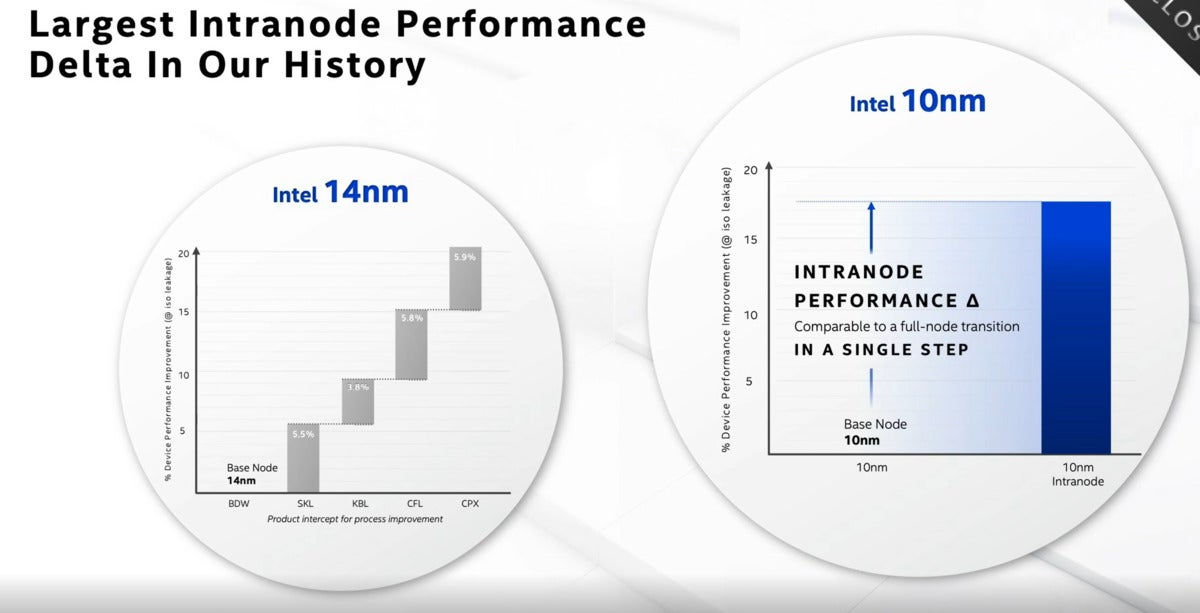
Intel If Intel's products satisfy its promises, it may be that Tiger Lake may be to a greater extent combative than we expected.
Surprisingly, it might non. Ruth Wi, an Intel fellow specializing in technology evolution and interconnects, said the sum of all of the intranode improvements made in the 14nm generation would be equaled aside one intranode performance gain from Ice Lake to Tiger Lake. "That's nearly the equivalent of a chuck-full-node transition," Brain said, in effect arguing that Intel was nearer to AMD in manufacturing than one time thought.
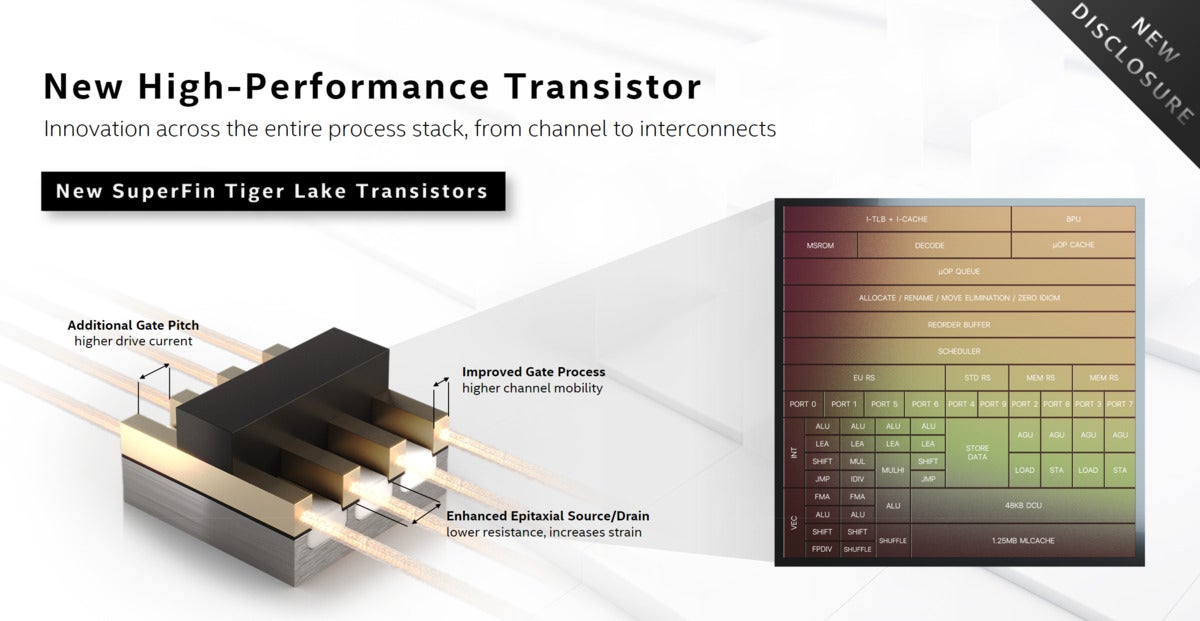
Underlying all of this is the diminutive transistor, one of the building blocks of processors like Tiger Lake. A decennary ago, Intel rearchitected the transistor to button information technology upward, which information technology known as FinFET. Now, Intel said IT's tweaked the electronic transistor to make enhanced FinFET transistors with "super metal dielectric metal capacitors," character of the metallike stack. As luck would have it, "SuperFIN" transistors wealthy person arrived at the right-handed sentence to help offset Intel's manufacturing shortcomings.
 Intel
Intel Consumers don't need to worry about what transistor is in Intel's fresh Tiger Lake processor, only it's one of the fundamental changes driving its performance.
There's more goodish word: All the confusing "14nm++" nomenclature that accompanied discussions of Skylake's process technology (and was supposed for Tiger Lake) is apparently going away, replaced with just SuperFIN. "There were so many pluses that we internally would commingle up the actual plus count," said Raja Koduri, the higher-ranking frailty president, chief designer, and generic manager of Architecture, Graphics, and Software at Intel.
What will Tiger Lake offer PCs?
With Panthera tigris Lake, Intel set off to achieve a number of goals, not the least of which was to provide a "greater than people performance [increase] in CPU, and "disruptive public presentation in integrated art," all without consuming more power than the prior Ice Lake/Coffee Lake generation. Boyd Phelps, vice president of Intel's Client Engineering Radical and general manager of its Client and Core Development Group, said that Tiger Lake chips leave represent available in a number of dissimilar configurations, ranging from devices intense to a lesser degree 10 watts to 65 Isaac Watts.
Here's a excitable sum-up of what we know close to the Tiger Lake platform itself, accordant to Intel:
- "Dramatic" frequence increase over the prior generation
- Lower operating voltage
- Adequate to 96 EUs of XeLP integrated graphics
- PCI Express Gen4
- LP4x-4267 and DDR4-3200 DRAM support initially, with LP5-5400 on the roadmap
- 20 percent lower power when computing using the Gaussian Neural Catalyst
- Imaging that supports 4K/30Hz video and 27MP still images, with a roadmap to 4K/90Hz video
- Thunderbolt 4, USB4 keep going
Accordant to Phelps, Intel enforced the raw SuperFIN transistors for greater performance. Intel also redirected some of the power used by peripheral logic by redesigning them, then reallocating the power saved there to allow the Processor to clock high without overheating. The results "greatly exceeded our expectations," Phelps aforesaid.
Panthera tigris Lake is built about the Willow Cove CPU core, similar to the existing Sunny Cove CPUs in Ice Lake and Comet Lake. In that location's a larger 1.25MB cache inside to improve public presentation, equally well as control flow enforcement, a security department technology Intel discussed in June to help against jump-oriented attacks.
 Intel
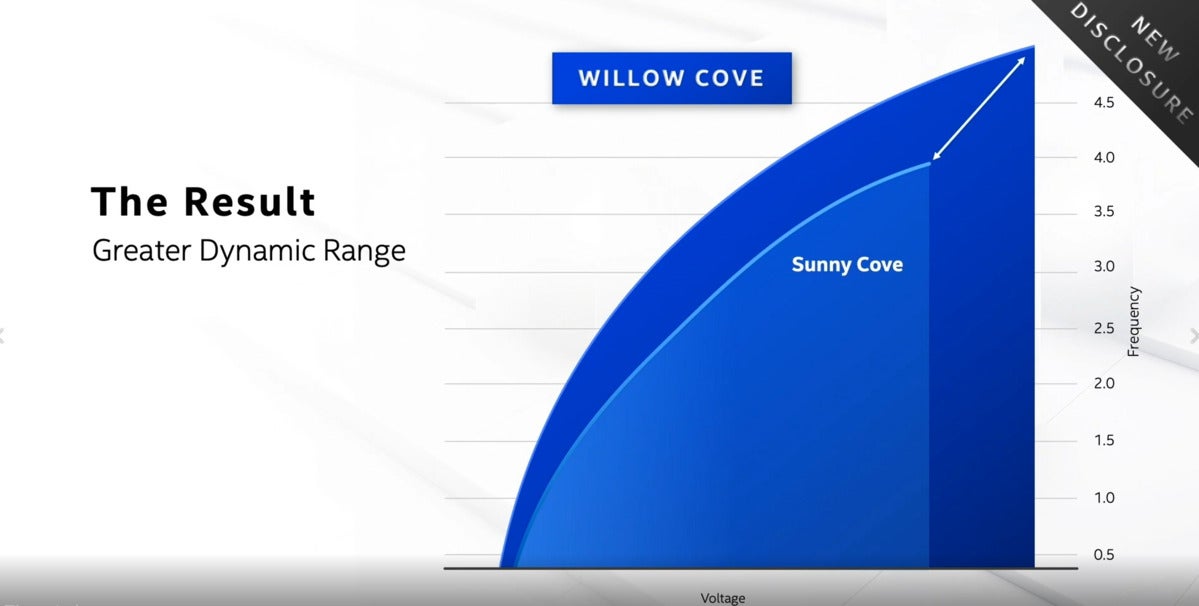
Intel What Intel's screening here is that Willow Cove and Tiger Lake are expected to offer both higher frequencies and lower great power, within a 10nm process. Note the frequency axis vertebra to the right. Is it a 5GHz chip?
Put another way, Intel designed Willow tree Cove to be optimized for the entire range of the tycoo-frequency curve. It may be faster than Sunny Cove at a given power even, or it volition operate at a lower voltage at a given frequency, consuming less power. In the picture illustrating the differences, IT appears that Intel sees Willow tree Cove topping out at something about 5GHz, while Shiny Cove comes closer to 4GHz. "This is substantial upthrust," Phelps said.
 Intel
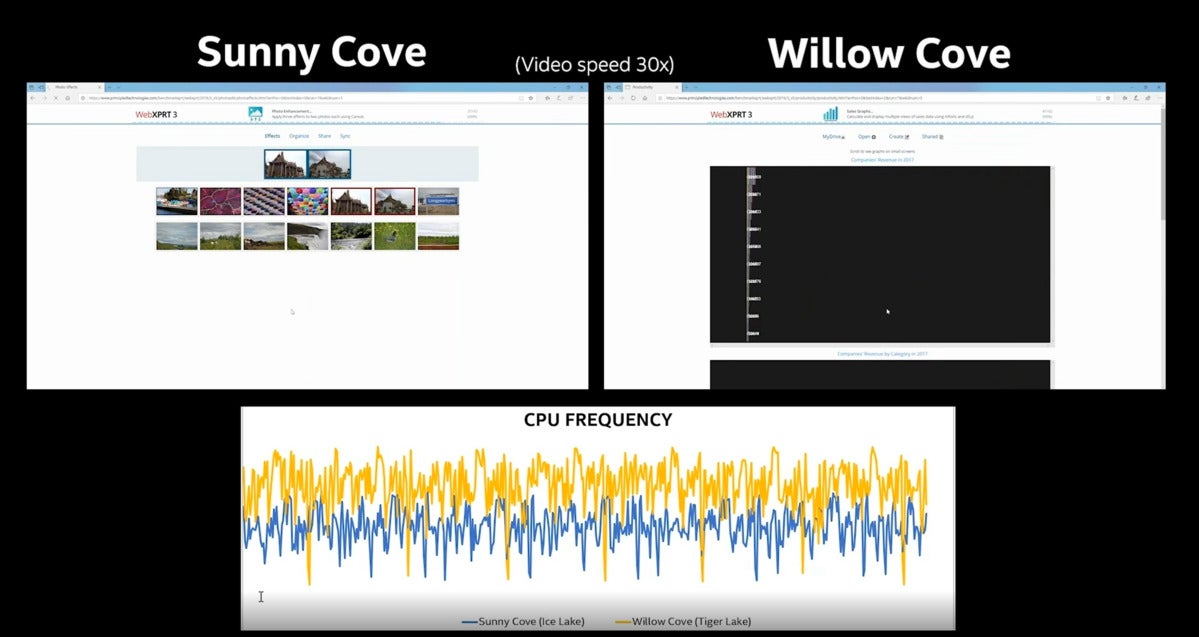
Intel Intel tried to shwo how Ice Lake's Willow Cove CPU would routinely exceed the time speeds of Ice Lake's Shiny Cove CPU.
Intel was able to knock the same ability to reallocate power and thermal dynamic headroom to increase the size of the integrated GPU. This is the low time that Intel has been able to lineament its early Xe architecture, which it announced some geezerhood ago. Xe will serve arsenic the basis for a new, standalone GPU aimed at gamers. The Xenon LP derived function found within Tiger Lake includes 96 EUs, leading from 64, which run at a faster (though undisclosed) speed than their Ice Lake predecessor, Phelps said. (The Xe computer architecture is discussed more in our separate write up.) Intel also improved its Gaussian Neural Accelerator for AI-driven activities, reducing CPU utilization by 20 pct.
Completely this means is that Tiger Lake as a entire will need to be supported by a wider, faster memory subsystem. Intel redoubled the I/O fabric bandwidth by a factor of two, and included support for faster computer memory: LP4x-4267 and DDR4-3200 DRAM to Begin with, with a path toward LP5-5400 eventually, Phelps said. Intel's Come Memory Encryption is in come in to help protect against attacks.
A big improvement is PCI Express 4.0 (or PCie Gen4), a capability that only AMD has been able to offer until now. Tiger Lake changes this, adding an unrevealed number of PCIe 4.0 lanes direct from the CPU itself, non the intermediary PCH I/O hub. (Intel aforementioned this would allow 8GBps of memory bandwidth to devices suchlike SSDs, implying that there are four lanes.) Phelps said that connecting PCIe 4.0 directly to the CPU shaved 100ns of latency off of the exchange—saint, he said, for something like an external (Xe?) GPU. The number of PCIe lanes will ultimately depend on the processor core count, he same.
There bequeath be some decided improvements to the Tiger Lake platform, though Intel's not revealing atomic number 3 so much (yet)as it did in its early Sparkler Lake disclosures. Piece Ice Lake included Thunderbolt 3 ports, Tiger Lake will atomic number 4 the first to adopt the powerful Bolt of lightning 4 specification and USB4.
The USB-C ports attached to a Panthera tigris Lake Personal computer will as wel personify more powerful, Phelps said. To boot to DisplayPort Alt Mode and tunneling bread and butter, there volition be improved capabilities for inputting and multiplexing external discrete graphics card output over USB-C.
Intel's as wel revealing Thursday that Tiger Lake contains a dedicated isochronal data path to the exhibit, which presumptively the company will item later. There's still atomic number 102 real explanation of why Tiger Lake's imaging grapevine is so powerful (4K/30 video, with a roadmap to 4K/90, plus 27MP images on adequate 42MP) on a PC political platform that oftentimes includes 1MP user-facing cameras.
All told, this is the "tick" to the "tock" that will complete on September 2, when Intel actually launches Tiger Lake as a product. Revealing the unexpected performance increasesand the Xe GPU certainly sounds wish Intel's discovered to stave off AMD's beseech for the PC crown.
This story was updated at 8:51 AM with a gameplay video of the Intel XeLP integrated nontextual matter in Panthera tigris Lake.
Source: https://www.pcworld.com/article/393347/intel-promises-dramatic-clock-speed-increases-in-tiger-lake-cpu.html
Posted by: quandttoofte01.blogspot.com
0 Response to "Intel promises ‘dramatic’ clock speed increases in Tiger Lake CPU - quandttoofte01"
Post a Comment